

How we explain lab results
The explanation comes from the rules of a medical reference, not from a neural network. Doctors write and review it. That is why the same results always get the same answer.
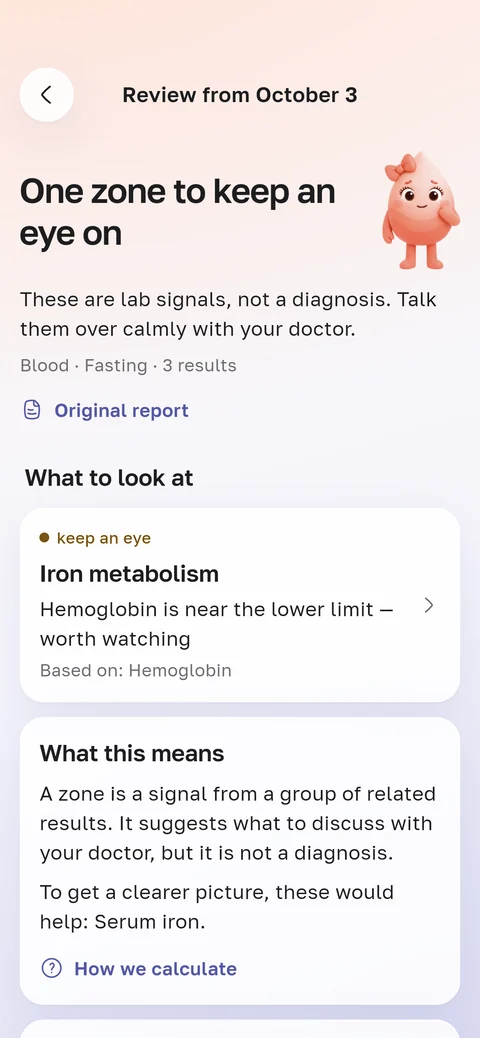
The same answer every time
In HemoTrack the neural network only reads the lines of the report. It does not write the explanation: that comes from the rules of a medical reference kept and checked by doctors.
A chatbot
- Answers the same question differently each time.
- Can be confidently wrong and invent what the report does not say.
- It is not always clear where the answer came from.
HemoTrack
- One report always gets one explanation. Today and a month from now.
- If the report has no range or the reference does not know a result, the app says so.
- Every explanation rests on a rule of the reference.
Who does what
What the neural network does
The neural network has one job: reading the report. It finds the result lines in a photo or a PDF.
In each line it separates the name, the number, the unit and the lab’s limits. It writes no explanations.
You see what it has read before the explanation. If a line was read wrong, you can fix it.
What the reference does
The explanation is built from a medical reference. For every test it records:
- what it is called on reports from different labs;
- which units it comes in and how to convert them;
- which body system it belongs to;
- which doctor to see about it and what else to test.
The reference takes sex, age and pregnancy into account. The rules differ for each.
Where the limits come from
We take the limits from your report. Every lab has its own, depending on its method and equipment.
If the report has no limits, the app says so. It keeps the value but does not rate it, so as not to get it wrong.
near the lower limit · keep an eye on itrange 13–150
How zones are assigned
Every result gets one of three zones. The colour always comes with words.
within the lab’s rangerange 13–150
Within the lab’s limits
The value is inside the limits on your report. Nothing needs to be done.
near the lower limit · keep an eye on itrange 13–150
Keep an eye on it
The value is right at a limit or has clearly shifted over several tests. It is worth retesting or asking your doctor about it.
below the range · needs attentionrange 13–150
Attention zone
The value is outside the lab’s limits, or several related results point the same way. It is a reason to talk to a doctor. The app suggests which specialist to see and what else to test.
What the app never does
- It does not diagnose.
- It does not prescribe treatment or medicines.
- It does not replace a doctor.
If a test is not yet described in the reference, the app says so plainly. It does not guess.
Who reviews the texts
Texts about lab tests and journal articles are reviewed by a medical editor. A draft may come from an editor or a neural network. Only the medical editor publishes a text, after the review.
Every reviewed text carries a signature and the review date. Once every 12 months the text is read again and updated if needed.
New reference rules are reviewed too. They reach the app only after that.
- DraftAn editor writes the text from a plan.
- ReviewThe medical editor edits it or sends it back.
- PublishingA signature and a date appear under the text.
- Re-reviewAfter 12 months the text is checked again.
Found a mistake?
If an explanation in the app or a text on this site looks wrong, write to us. Name the test and what worried you. We will check and reply.
The app does not diagnose and does not replace a doctor. You make health decisions together with your doctor.